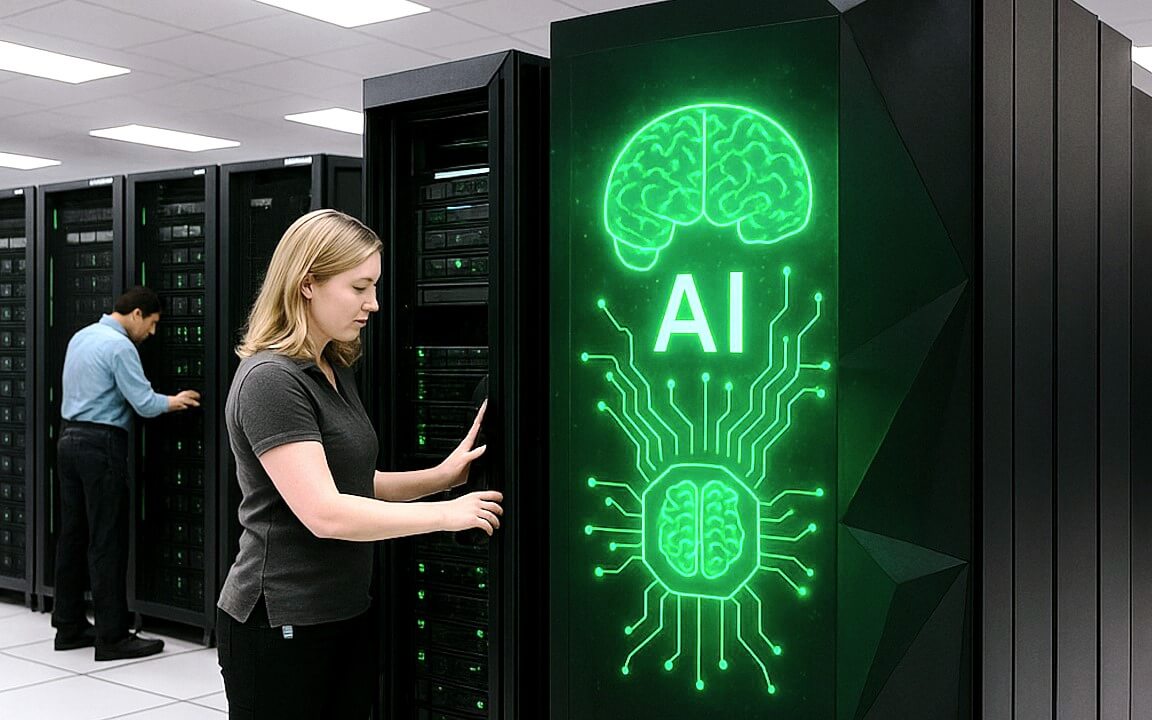
A glance at the architecture of today's "AI factories" reveals a powerful contradiction. These data centers are marvels of concentrated power, sprawling across vast floor-spaces and consuming megawatts of electricity. Inside, tens of thousands of high-performance GPUs are aggregated into a single location to train and operate the colossal neural networks that define our era. Yet, from a design perspective, they remain profoundly fragmented. They are, in essence, a vast collection of individual servers stitched together by a complex and costly network—a design philosophy inherited from the distributed computing revolution.
This architecture, which has served us well for decades, is now creaking under the unique strain of large-scale AI. As we continue to build ever-larger models and centralize immense computational power, a fundamental question emerges: is there a better way? Instead of scaling out with thousands of separate boxes, should we be scaling up with a more hyper-integrated, application-specific architecture? It is time to seriously re-examine the core principles of the mainframe, not as a relic of the past, but as a potential blueprint for the future.
The Pendulum of Architecture: Why Now?
The idea seems almost heretical. The technology industry spent the better part of three decades moving decisively away from the monolithic mainframe. The rise of commodity x86 processors, the open-source revolution with Linux, and the principles of fault-tolerant, distributed systems allowed for incredible flexibility and cost-effectiveness. This shift gave us the modern internet and the cloud infrastructure upon which the first wave of AI was built.
However, the very nature of large-scale AI workloads is causing this architectural pendulum to swing back. The challenges are no longer about handling millions of independent user requests, but about running a single, massive computational problem—a large language model—that is itself a distributed system, with its trillions of parameters sharded across thousands of processors. This creates a new set of extreme bottlenecks that today’s architectures are ill-equipped to handle.
The limitations of the current GPU-centric model are becoming starkly clear:
- The Memory Wall: A top-tier GPU has a finite amount of extremely fast but expensive High-Bandwidth Memory (HBM)—typically 80GB to 144GB. The largest AI models are hundreds of gigabytes or even terabytes in size. This means the model cannot fit on a single chip, forcing it to be split across many GPUs. The performance of the entire system is then limited by the speed at which these chips can communicate with each other.
- The Interconnect Bottleneck: Even with state-of-the-art interconnects like NVIDIA’s NVLink and InfiniBand, the speed of communication between servers is orders of magnitude slower and more power-hungry than communication within a single chip. This "off-node" communication becomes the primary bottleneck and a major source of energy consumption in large training runs, a problem often referred to as "data gravity."
- The Power and Cost Inefficiency: The immense power draw of thousands of GPUs, each consuming up to 700 watts or more under load, translates directly to a staggering Total Cost of Ownership (TCO). A large training cluster can consume as much electricity as a small town, a cost that is ultimately passed down to every user of the AI service. Furthermore, GPUs are general-purpose parallel processors, with much of their silicon dedicated to graphics rendering and other tasks not strictly necessary for AI. This inherent lack of specialization leads to wasted power and performance potential.
Real-World Precursors: The Industry is Already Shifting
This re-evaluation is not just theoretical. The industry's most advanced players are already moving toward more integrated, specialized hardware, laying the groundwork for a mainframe-like future. Their motivation is clear: to break free from the limitations of general-purpose hardware, vertically integrate their AI stack, and optimize their TCO to create a sustainable competitive advantage.
This has led to a surge in the development of Application-Specific Integrated Circuits (ASICs):
- Google's Tensor Processing Units (TPUs) have been the vanguard of this movement for nearly a decade. Designed from the ground up for neural network operations, TPUs feature massive systolic arrays—grids of simple multipliers and accumulators—that are perfectly suited to the matrix math that dominates AI, delivering unparalleled performance-per-watt for these specific tasks.
- Amazon Web Services, in its quest to control its own destiny, has developed two families of custom chips: Trainium for cost-effective training and Inferentia for high-throughput, low-latency inference. By offering these on its cloud, AWS can provide more economical AI services and reduce its dependency on external vendors.
- Meta, Microsoft, and others are deep in similar multi-billion-dollar R&D efforts. The immense Non-Recurring Engineering (NRE) costs of designing a new chip are justifiable when operating at a scale of billions of users, where even marginal efficiency gains translate into hundreds of millions of dollars in savings.
Simultaneously, IBM, the original mainframe innovator, provides the most explicit link between this history and the future. The modern IBM z17 mainframe is not just a powerful transaction processor; it is an AI machine. Its Telum processor features an on-chip AI accelerator integrated directly with the general-purpose cores. Imagine a credit card transaction hitting the system. The transaction details are processed by the main cores, which can then make a function call to the on-chip AI accelerator to get a real-time fraud score. The entire process, from transaction to AI-powered insight, can occur in microseconds, without the data ever leaving the security of the chip. This demonstrates the profound value of co-locating AI compute with mission-critical data and operations.
A Conceptual Blueprint for an AI Mainframe
These real-world examples provide the components and the justification to explore the next logical step. What would a purpose-built, hyper-integrated AI Mainframe, designed from first principles for today’s workloads, actually look like?
1. The Core: A Unified Interconnect Fabric
The foundational element would be the replacement of the traditional network with a unified, high-bandwidth interconnect fabric. This is where a technology like Compute Express Link (CXL) becomes transformative. CXL is an open standard that runs over the physical PCIe bus, but it enables much more than simple data transfer. Its different protocols allow for:
- Memory Pooling (CXL.mem): Processors across the system can access vast, shared pools of memory as if it were their own local memory. This would allow a multi-terabyte model to be loaded into a central memory pool, accessible to all accelerators with low latency.
- Cache Coherency (CXL.cache): This allows different processors (like a CPU and an ASIC) to work on the same data in their respective caches while ensuring that the data remains consistent across the entire system.
This fabric would effectively dissolve the boundaries between individual servers, creating one giant, coherent machine and directly attacking the interconnect bottleneck that plagues current clusters.
2. The Engine: Heterogeneous, Blade-Based Compute
The machine would not be a monolith of one type of processor. It would be a modular system of specialized blades, each optimized for a specific task and plugging into the unified fabric.
- GPU Compute Blades: These would remain essential for flexibility and research. Their powerful programmability is ideal for training models with novel architectures (like sparse Mixture-of-Experts or new attention mechanisms) and for handling workloads requiring high-precision formats like FP32 or BF16.
- ASIC Inference Blades: This is where the bulk of production work would happen. These blades would be densely packed with ASICs designed for one purpose: high-speed, quantized inference (INT8/INT4). By stripping away all unnecessary logic, these chips can dedicate their entire silicon budget to the matrix engines that power inference, achieving an order of magnitude improvement in TOPS/watt (tera-operations per second per watt) over general-purpose hardware.
- CPU & DPU Service Blades: These are the system's overseers. The CPUs would handle high-level orchestration, job scheduling, and running the host operating system. Critically, they would be paired with Data Processing Units (DPUs). A DPU is a sophisticated, programmable processor with its own cores and memory, designed to offload the entire infrastructure stack. It can manage the unified fabric, run storage protocols like NVMe-oF, handle virtualization overhead, and enforce security policies, freeing up every last cycle of the expensive CPU and AI accelerators for their primary tasks.
3. The Life Support: Integrated Power and Thermal Management
Achieving this level of compute density creates immense power and thermal challenges. A rack could easily draw over 50 kilowatts. Consequently, direct-to-chip liquid cooling would be non-negotiable. Cold plates would be mounted directly onto every major processor, efficiently wicking away heat with a circulating fluid. This not only enables density but also reduces noise and can allow for higher, more stable clock speeds. The power system would be similarly integrated, using a high-voltage DC distribution architecture (like 48V DC) to minimize the number of wasteful power conversions from the grid to the chip.
4. The Soul: A Unified Software and Orchestration Layer
This sophisticated hardware would be inert without an equally sophisticated software stack. The operating system would need to present a "single-system image" (SSI), making the entire collection of blades and fabrics appear as one giant computer to developers and applications. The job scheduler—likely a highly advanced, topology-aware version of Kubernetes—would need to understand the physical layout of the machine, placing communicating parts of a workload on physically adjacent blades to minimize latency. Finally, a new generation of compilers would be needed to automatically partition a neural network graph, intelligently dispatching different operations to the optimal hardware—sending highly parallelizable, quantized layers to the ASICs and more complex or novel layers to the GPUs.
The Pragmatic Path Forward: From Pods to Mainframes
The economic and logistical hurdles of building such a monolithic machine are, for now, immense. This suggests a more practical, evolutionary path. The industry is already moving toward the concept of the "AI Pod"—a pre-integrated, self-contained rack that embodies these principles on a smaller scale. A single pod might come with a mix of GPU and ASIC blades, its own liquid cooling system, and a CXL-based fabric switch.
An organization could start with one or two pods and, as their needs grow, add more. These pods could then be interconnected with a high-speed optical fabric, allowing a collection of pods to function as a larger, disaggregated mainframe. This modular approach offers a bridge to the future, providing many of the benefits of hyper-integration without the prohibitive upfront risk and cost of a single, giant chassis.
Conclusion: Applying Proven Principles to a New Frontier
The classic mainframe of the 1960s is not returning. But the core architectural principles it championed—deep integration, resource centralization, specialization, and reliability—are becoming more relevant than ever. The challenges posed by large-scale AI are forcing a fundamental re-evaluation of the distributed computing dogma that has dominated the last thirty years.
The future of high-performance computing for AI will likely be a convergence. It will blend the raw power of HPC with the specific needs of AI, creating a new class of machine. Whether this machine ultimately looks like a single, monolithic chassis or a disaggregated cluster of hyper-integrated pods, the direction of travel is clear. We are moving away from fragmentation and toward cohesion. By thoughtfully applying the lessons of the past to the problems of the present, we can begin to build the powerful, efficient, and truly integrated systems needed to unlock the next generation of artificial intelligence.